AI Search vs Google Search: Traffic, Leads & ROI Breakdown (2026)
The way people search online has changed faster in the last two years than in the previous decade. Businesses that once depended only on traditional SEO now face a new reality shaped by AI-driven search experiences. If you want to stay competitive, you need to clearly understand AI Search vs Google Search and how each one impacts traffic, leads, and overall return on investment.
Many business owners still rely heavily on Google rankings. That approach worked well for years. However, AI search platforms now answer questions directly, reduce clicks, and reshape how users interact with content. This shift creates both risks and opportunities.
In this article, you will learn how AI Search vs Google Search differs in terms of traffic generation, lead quality, and ROI. You will also understand where each channel performs best and how to use both effectively in 2026.
Here are the 7 key differences between AI Search and Google Search:
1. Fundamental Differences: AI Search vs Google Search
Before comparing traffic, leads, and ROI, you need to clearly understand how AI Search vs Google Search actually works at a core level. This difference shapes everything from visibility to conversions.
| The real shift in AI Search vs Google Search is how decisions happen, where Google offers multiple paths to explore while AI search delivers one clear answer that drives faster action. |
Google Search operates as a discovery-driven system. Users enter queries, review multiple results, and choose which websites to visit. Your traffic depends on how well your pages rank and how effectively they attract clicks.
AI Search, on the other hand, works as a response-driven system. Users ask direct questions, and the platform delivers a single, structured answer. In many cases, users get what they need without visiting any external website.
This shift changes how users interact with content, how businesses gain visibility, and how traffic flows across the web.
To understand this clearly, look at the comparison below.
| Aspect | Google Search | AI Search |
|---|---|---|
| Core Function | Discovery engine that lists multiple sources | Answer engine that delivers a direct response |
| User Behavior | Users explore, compare, and click multiple links | Users expect instant, summarized answers |
| Click Dependency | High – traffic depends on ranking and CTR | Low – visibility does not always generate clicks |
| Traffic Flow | Drives consistent website visits | Often reduces traditional website traffic |
| Visibility Type | Based on ranking positions (Top 10 results) | Based on inclusion in AI-generated answers |
| Content Preference | Keyword-optimized, long-form content | Clear, structured, context-rich answers |
| Decision Journey | Longer and research-based | Shorter and decision-focused |
| Control Over Experience | High (website controls UX and conversion) | Limited (AI controls presentation) |
| Competition Level | Highly competitive across industries | Currently lower but rapidly increasing |
| Measurement | Easy to track (analytics, CTR, rankings) | Difficult to track (limited attribution) |
This comparison highlights why the discussion around AI Search vs Google Search is no longer optional for businesses. It is a fundamental shift in how digital visibility and user engagement work in 2026.
2. Traffic Comparison Between AI Search and Google Search
Traffic remains one of the most important metrics for any business. However, in 2026, the meaning of traffic is no longer the same. When you compare AI Search vs Google Search, you need to look beyond just the number of visitors and focus on how visibility actually works.
Google continues to dominate traditional traffic generation, but AI search is changing how users consume information. This shift directly impacts how much traffic you receive and how valuable that traffic becomes.
Let’s break this down clearly.
Google Search Traffic: High Volume, Click-Driven Growth
Google Search still drives a significant share of global website traffic. When your website ranks on the first page, especially in the top positions, it attracts consistent and scalable clicks.
This makes Google a powerful channel for businesses that depend on steady traffic flow.
Advantages
- High traffic volume potential
- Consistent and scalable growth over time
- Strong intent-based searches from users
Limitations
- Highly competitive rankings across industries
- Declining click-through rates due to SERP features
- Requires continuous SEO investment
Google traffic performs best when users want to explore options, compare solutions, or conduct detailed research before making a decision.
AI Search Traffic: Low Clicks, High Visibility Impact
AI search introduces a completely different traffic model. Instead of sending users to multiple websites, it delivers direct answers within the platform itself.
This reduces traditional website visits but increases how often your brand appears in front of users.
Advantages
- Strong visibility within AI-generated answers
- Faster user engagement and interaction
- Lower competition compared to traditional SEO (for now)
Limitations
- Reduced click-through rates to websites
- Limited control over how content appears
- Difficult to track and measure traffic accurately
AI search works best when users want quick answers and immediate solutions without browsing multiple sources.
Key Insight: Traffic vs Visibility Shift
The biggest change in the AI Search vs Google Search landscape lies in how traffic behaves.
- Google focuses on bringing users to your website
- AI focuses on bringing your content to the user
This difference changes how you should measure success.
Traffic Reality in 2026
Most businesses still chase traffic numbers without understanding the shift happening underneath.
Here’s the reality:
- Google gives you visits and sessions
- AI search gives you visibility and impressions without clicks
If you focus only on traffic, you will miss the impact of AI-driven exposure.
To succeed in the AI Search vs Google Search ecosystem, you need to build a strategy that captures both visibility and visits, not just one of them.
3. Lead Generation Comparison Between AI Search and Google Search
Leads define real business growth, not just traffic. When comparing AI Search vs Google Search, the difference lies in how many leads you generate and how quickly those leads convert. Google focuses on volume, while AI search focuses on intent and speed.
| Factor | Google Search | AI Search |
|---|---|---|
| Lead Volume | High | Low to Medium |
| Lead Intent | Medium to High | High |
| Conversion Speed | Slower | Faster |
| User Journey | Multi-step (search → browse → decide) | Short (ask → answer → decide) |
| User Behavior | Compares multiple options | Trusts direct answers |
| Drop-off Rate | Higher | Lower |
Google helps you generate more leads at scale, while AI search helps you capture high-intent leads that convert faster. A balanced strategy between both is essential to maximize results in the AI Search vs Google Search landscape.
4. ROI Comparison & Business Value Between AI Search and Google Search
Return on investment defines where businesses should spend time and budget.
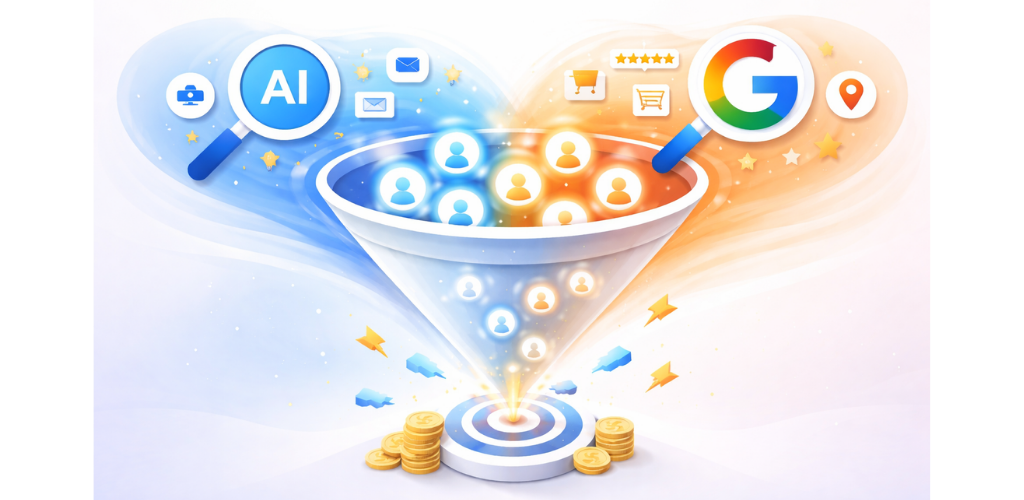
When comparing AI Search vs Google Search, the difference comes down to long-term stability versus faster early results.
ROI from Google Search
Google SEO requires consistent effort. You need content, optimization, and backlinks to build rankings over time. Results do not come instantly, but they tend to last longer once established.
Cost Factors:
- Content creation
- SEO optimization
- Link building
- Technical improvements
ROI Benefits:
- Sustainable traffic growth
- Long-term rankings
- Scalable and predictable results
ROI from AI Search
AI search requires a different approach. The focus shifts toward clear, structured content and building authority that AI systems can trust and reference.
Cost Factors:
- Content restructuring
- AI-focused optimization
- Entity and authority building
ROI Benefits:
- Faster visibility in AI answers
- Higher trust and credibility
- Early-mover advantage in a growing space
Key ROI Difference:
- Google delivers stable, long-term returns
- AI search delivers faster visibility and early gains
Businesses that rely only on long-term SEO may grow slowly, while those focusing only on AI may face uncertainty as the space evolves. The most effective strategy in AI Search vs Google Search is to balance both—combining steady growth with early opportunities.
5. User Behavior Differences in AI Search and Google Search (2026)
User behavior plays a direct role in how search platforms evolve. When comparing AI Search vs Google Search, the difference becomes clear in how users interact with information. On Google, users explore multiple sources, read blogs, check reviews, and spend time researching before making a decision. This process involves more steps and requires users to actively evaluate different options.
| What used to take multiple clicks and comparisons in Google now happens instantly in AI search. |
AI search changes this behavior by simplifying the journey. Users ask direct questions, receive summarized answers, and make faster decisions without browsing multiple websites. This shift reduces scrolling and clicks while increasing speed and convenience. Understanding this change is essential if you want to align your strategy with how users actually behave in the AI Search vs Google Search landscape.
6. Content Strategy Differences Between AI Search and Google Search
Content strategy directly impacts how your website performs across different search platforms. When comparing AI Search vs Google Search, the way you create and structure content needs to change based on how each system evaluates and presents information.
Google-Focused Content
To perform well on Google, your content should focus on discoverability and ranking signals:
- Keyword optimization for search visibility
- Long-form content to cover topics in depth
- Internal linking to improve site structure
- Backlinks to build authority and rankings
AI-Focused Content
To perform well in AI search, your content should focus on clarity and direct answers:
- Clear and precise responses to user queries
- Well-structured content for easy extraction
- Strong authority and trust signals
- Context-rich information for better understanding
AI search prioritizes clarity and direct answers, while Google rewards depth and optimization. This difference defines how you should approach content in the AI Search vs Google Search strategy.
Practical Use Cases for AI Search and Google Search
Choosing the right channel depends on your business model and user intent. When comparing AI Search vs Google Search, each platform performs better in different situations.
When Google Search Works Best
Google delivers strong results when users need to explore and evaluate options before making a decision:
- Blogging and content marketing
- E-commerce and product discovery
- Informational and research-based queries
- Long and complex buying cycles
When AI Search Works Best
AI search performs better when users want quick answers and are ready to act:
- Service-based businesses
- Quick decision queries
- Local service searches
- High-intent questions
Example Scenario
Google Search
A user searching on Google might type, “Best real estate agents near me” and review multiple websites before choosing.
AI Search
On AI search, the same user may ask, “Who is the best real estate agent in my area?” and rely on a direct answer to make a faster decision.
Google supports discovery and comparison, while AI search supports faster decisions. Using both effectively strengthens your overall AI Search vs Google Search strategy.
FAQs About AI Search vs Google Search
No, AI search is not likely to fully replace Google search. Instead, both will evolve together, with Google integrating AI features while still maintaining traditional search results.
Businesses can optimize for AI search by creating clear, structured content, answering specific questions, and building strong authority and credibility in their niche.
Yes, AI search can impact traditional SEO by reducing clicks and changing how content is discovered, but strong SEO still plays a key role in visibility.
Service-based industries, local businesses, healthcare, legal services, and real estate tend to benefit the most due to high-intent and question-based queries.
AI search can provide more direct and contextual answers, but its accuracy depends on data sources and may not always be perfect compared to traditional search results.
AI platforms prioritize structured content, relevance, authority, and clarity when selecting information to generate responses.
Small businesses should focus on both, using Google for traffic and AI search for visibility and faster decision-making opportunities.
Tracking AI search performance is challenging, but businesses can monitor brand mentions, referral traffic trends, and overall visibility in AI-generated responses.
Final Thought
Businesses that succeed will not choose between AI search and Google search. Instead, they will combine both to maximize results. Google will continue to drive consistent traffic, while AI search will influence faster decisions and high-intent actions. A balanced approach ensures you capture visibility, build trust, and generate sustainable growth in the evolving search landscape.
Share This Post
RELATED RESOURCES
Checkout Our Latest Articles & News Updates

 Sam M.
 Anish P.

We, as a digital marketing agency, offer a complete package of web design, development, and online marketing services to help you achieve your business goals. At VerifiedCliq Solutions, we offer exceptional SEO services that utilize cutting-edge strategies to optimize your website both on and off the site, ensuring remarkable results.
©2021-2026 VerifiedCliq Solutions. All Rights Reserved. Sitemap | Privacy Policy | Terms of Service